

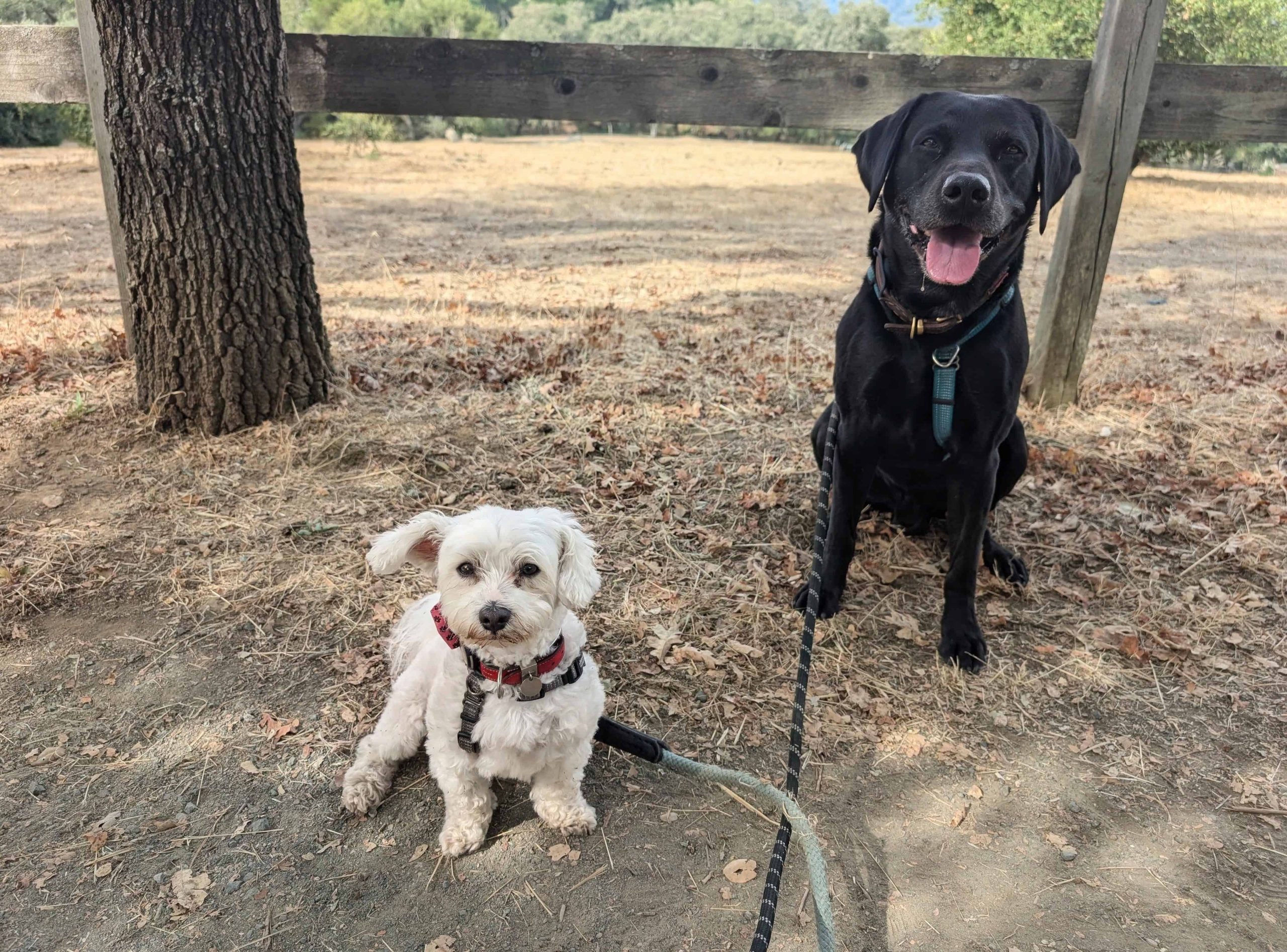
Dog walking for a two-dog household usually works well as a shared outing when they get along, remain manageable on leash, and enjoy a pace that suits them both. Separate walks can make sense when their needs or behavior make walking together difficult. Some households benefit from a combination: a shared walk, followed by extra solo time for one dog.
If you have two dogs and a demanding workday, you want both of them cared for without having to coordinate two different routines yourself. The right arrangement starts with understanding each dog and how they do together.
At Simply The Best Pet Care, that sometimes means one straightforward neighborhood walk. Other times, it takes a little observation, honest feedback, and collaboration with the household to find the right fit.
Adi and Leo are a perfect example.
Two dogs, two very different ideas of a good walk
Adi is a high-energy, sporting-line Black Lab who gets two hours of walking with our team Monday through Friday. He has plenty of enthusiasm for getting out and moving.
His housemate, Leo, is a 10-pound Bolognese who loves to sniff and explore. Long, vigorous outings are much less his style.
Their household needed a weekday routine that accommodated both dogs. After working with them, communicating back and forth, and sharing our honest observations, we settled on a plan that we still use almost 18 months later:
| Part of the outing | Adi | Leo |
|---|---|---|
| First hour | Walks with Leo at a pace that accommodates his needs. | Enjoys a substantial outing with time to sniff. |
| Second hour | Continues on a solo walk, with room for a brisker pace. | Finishes his outing and stays home. |
| Total walking time | Two hours. | One hour. |
Leo gets his sniffing and exploring time, and Adi gets the longer outing he enjoys, including an hour devoted to his preferred pace.
For their family, it is one established weekday arrangement. They do not need to work out each morning how to accommodate two dogs with very different energy levels.
Their schedule is specific to them, which is why it works so well! It’s worth noting that this is not a generalized recommendation for every Lab and every small dog. The American Kennel Club explains that exercise needs vary with age, health, and breed. Your dogs’ routines should reflect their individual needs, with veterinary guidance when health or mobility concerns are involved.

Walking dogs from the same household together is our default
At STB, we generally walk household dogs together when there is no history of aggression between them and they do not rile each other up to the point that they become unsafe to handle. In our experience, this works well for the vast majority of our two-dog households.
Our private neighborhood walks are private to your household. That means your two dogs can share a walk without being grouped with unfamiliar dogs from other homes.
This is an important distinction when comparing private walks and pack walks. “Private” does not have to mean leaving one of your dogs behind.
Your dogs also do not need to be the same size, breed, or age to walk together. What matters is whether the walker can safely and comfortably manage them both and provide an outing that suits each dog.
Adi and Leo look very different and have different energy levels, but they still enjoy a shared first hour. Their routine works because we account for those differences.
When separate walks may be the better fit
We are happy to arrange separate, back-to-back walks if you have a reason to prefer them.
That might be worth discussing when:
- One dog needs a much slower or shorter outing than the other.
- Their veterinary or care instructions call for different routines.
- They become significantly more excitable or difficult to handle together.
- One dog’s reactions make it difficult to give the other an appropriate walk.
- You have noticed that they seem more comfortable on individual outings.
Getting along at home is helpful information, but we also want to understand what happens outside. Tell us how your dogs respond to passing dogs, squirrels, delivery trucks, and other everyday distractions – and whether those responses change when they are together.
Be candid about any history of aggression or conflict. VCA Animal Hospitals explains that redirected aggression can occur when a frustrated dog directs aggression toward someone other than the original target. If aggression is a concern, discuss an appropriate care plan with your veterinarian or a qualified behavior professional before starting service. Please note that we cannot accept dogs with a history of human aggression, but we can work with those who have other-dog reactivities.
Sharing these details helps us evaluate whether the proposed arrangement is a suitable fit for everyone involved.
When a shared walk plus extra solo time makes sense
Sometimes both dogs enjoy walking together, but one wants more activity than the other.
That is where an arrangement like Adi and Leo’s can be useful. The shared portion accommodates both dogs, then the dog who benefits from additional time continues separately.
This gives us flexibility without requiring the entire outing to follow the more energetic dog’s preferences. The dog who enjoys a gentler pace can have a satisfying walk, while their housemate still gets additional time to move.
The same principle can apply to other households, but the timing should be worked out around your dogs. We can discuss the shared portion, any additional solo time, and how the transition between them would work before establishing your recurring schedule.
We charge for time, not number of paws
There is no additional charge for a second dog from the same household at Simply The Best Pet Care.
We charge for time, not number of paws.
We offer 30-, 45-, and 60-minute visits. When your dogs share a visit, you pay for that time without a second-dog surcharge.
If your dogs need separate outings or one needs additional solo time, we plan and charge for the time required. Adi and Leo’s arrangement involves two hours of service because Adi continues after Leo’s outing ends. The additional cost reflects the additional time.
Visit time includes greeting your dogs, getting them ready, walking, and settling them back at home. Separate outings also need enough time for the transition between dogs. We will discuss the arrangement with you so expectations are clear before service begins.
What to tell us about your pair
You know your dogs’ habits, and those details are valuable. Before we begin, think about:
- Whether they have any history of aggression toward each other.
- How they behave together on leash compared with individually.
- Their preferred pace, usual outing length, and interest in sniffing.
- Whether one tends to pull the other along or encourage more excitable behavior.
- Any health considerations, walking restrictions, or instructions from your veterinarian.
- What already works well in your routine and what you would like help improving.
You do not need to arrive with a finished plan. We can talk through your observations, share our input, and decide on a practical starting point together.
Our guide to preparing your dogs and home for a new walker covers the equipment, access instructions, and care details to have ready.
A weekday routine that works for both dogs
Simply The Best Pet Care provides recurring weekday dog walking Monday through Friday, from 9am to 4pm in Redwood City, San Carlos, Menlo Park, Atherton, Emerald Hills, Downtown Woodside, and select parts of Palo Alto and Portola Valley.
Our small team of trained W-2 employees follows documented care instructions, with photos and a detailed visit report to keep you informed.
Whether you need dog walking in Redwood City or another community we serve, we will get to know both dogs and help you establish an arrangement that fits your household.
Schedule a complimentary meet and greet to introduce us to your pair and discuss their weekday routine. We would love to meet them!
Frequently asked questions about dog walking for two dogs
Can a large dog and a small dog walk together?
Yes, when their behavior, pace, and individual needs make a shared walk appropriate. Size alone does not determine the arrangement. Adi the Black Lab and Leo the Bolognese share an hour together, and Adi then continues for extra solo time.
Does private dog walking mean one dog at a time?
At STB, private means one household at a time. Your two dogs can walk together if they are a suitable pair. We do not combine them with dogs from other households.
Can I request separate walks for my dogs?
Absolutely! Tell us why you prefer separate walks, and we can discuss back-to-back outings and the time needed. Share any aggression or handling concerns before service begins so we can assess the proposed care arrangement.
Do you charge extra for a second dog?
Nope! We charge for time, not number of paws. Two dogs sharing a visit do not incur a second-dog fee. If the arrangement requires additional time, the charge reflects that time.
How do I get started with walks for my two-dog household?
Schedule your complimentary meet and greet here. You’ll meet with a member of our team, introduce us to your pets and their routine, and ask any questions you may have. We can’t wait to meet you!

Caroline Mameesh is the founder of Simply The Best Pet Care and has provided professional pet care on the San Francisco Peninsula since 2014. She leads STB’s small team of vetted, trained W-2 employees and specializes in private dog walking, in-home pet sitting, pet-care safety, and reliable care systems. Simply The Best Pet Care is insured and bonded, a member of Pet Sitters International, and Caroline is a dedicated student of DogCo Launch. She is committed to raising the bar for pet care. When she isn’t out with pets or working to make Simply The Best even better for her clients, she likes to put her knowledge and years of experience down on paper so she can share it with pet parents more easily. That’s why this blog was born!